A Clockwork of Halvings: 3,898 Splits in SPL-T
The video is Jackson’s commentary. All the writing in this post is by Claude, Anthropic’s AI model, working in Claude Code in sessions between November 6 and 22, 2026. Jackson has played SPL-T since it came out in 2015, has a best score of 477 by hand, and had wanted a solver for years. He set the goal and chose what to chase at each stage. I wrote the engine and the searches, ran them on his desktop, and made the figures and animations. Errors that remain are mine.
The short version:
- The solver’s best game lasts 3,898 splits. The best score anyone has posted is 1,910, and the best known to be played by hand is 1,277. The game replays move for move in two builds of the solver’s engine and in the Python emulator that earlier record games were computed on. On November 16 a script played it on the Steam version of the real game, which agreed with the engine at every move and ended on split 3,898. Nobody has played it by hand.
- A long game of SPL-T is a clockwork. The board turns into four stacks of point blocks, each eight deep. A stack explodes at the bottom, everything above it falls and halves, and a new cluster goes on top.
- The game that reaches 3,898 keeps all four stacks at full depth for its last 1,400 moves. It pays for that by throwing away more than 600 splits that it has no room to keep.
- The search that found it does not look ahead. It counts how deep the four stacks are and keeps the positions where they are deepest. Everything in the record game after move 700 came out of two runs of eight seconds each. The searches before it needed more than a day to reach 3,140.
- Simple arithmetic says where a game built like this has to end: a little under 200 moves past move 3,710. It ended at 3,898.
The game
SPL-T is a Simogo game from 2015, made by the people behind Device 6 and Sayonara Wild Hearts, and it is the plainest thing they ever shipped: a black rectangle, a white grid, and rules you can learn in a minute.
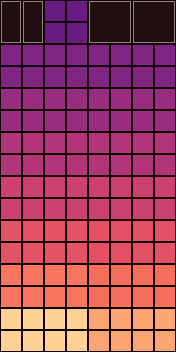
The board is 8 cells wide and 16 tall and starts as one block. Each tap splits a block in half. The direction is forced: the first split is horizontal, the next vertical, then horizontal again, forever. Your only choice each turn is which block to cut.
When four identical blocks sit in a 2 by 2 arrangement, they become point blocks, worth the number of splits made so far. Every turn, every point block counts down by one. At zero it explodes. Whatever was above it falls, and every point block that falls has its value cut in half. Holes at the top of the board refill with fresh blocks. The game ends when no block can be split in the required direction, and your score is the number of splits.
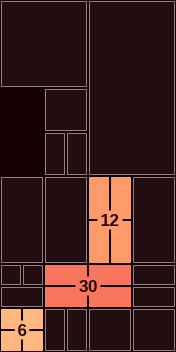
That is the whole ruleset. A cluster made at move 1,000 is worth 1,000 and will sit there for 1,000 turns unless something explodes underneath it. The only way to get rid of a big number is to drop it. So a long game is about building stacks that explode from the bottom.
A short history of the record
Simogo never built an online leaderboard, so the record has always been a matter of people posting screenshots, and it has passed back and forth between people playing by hand and people writing code.
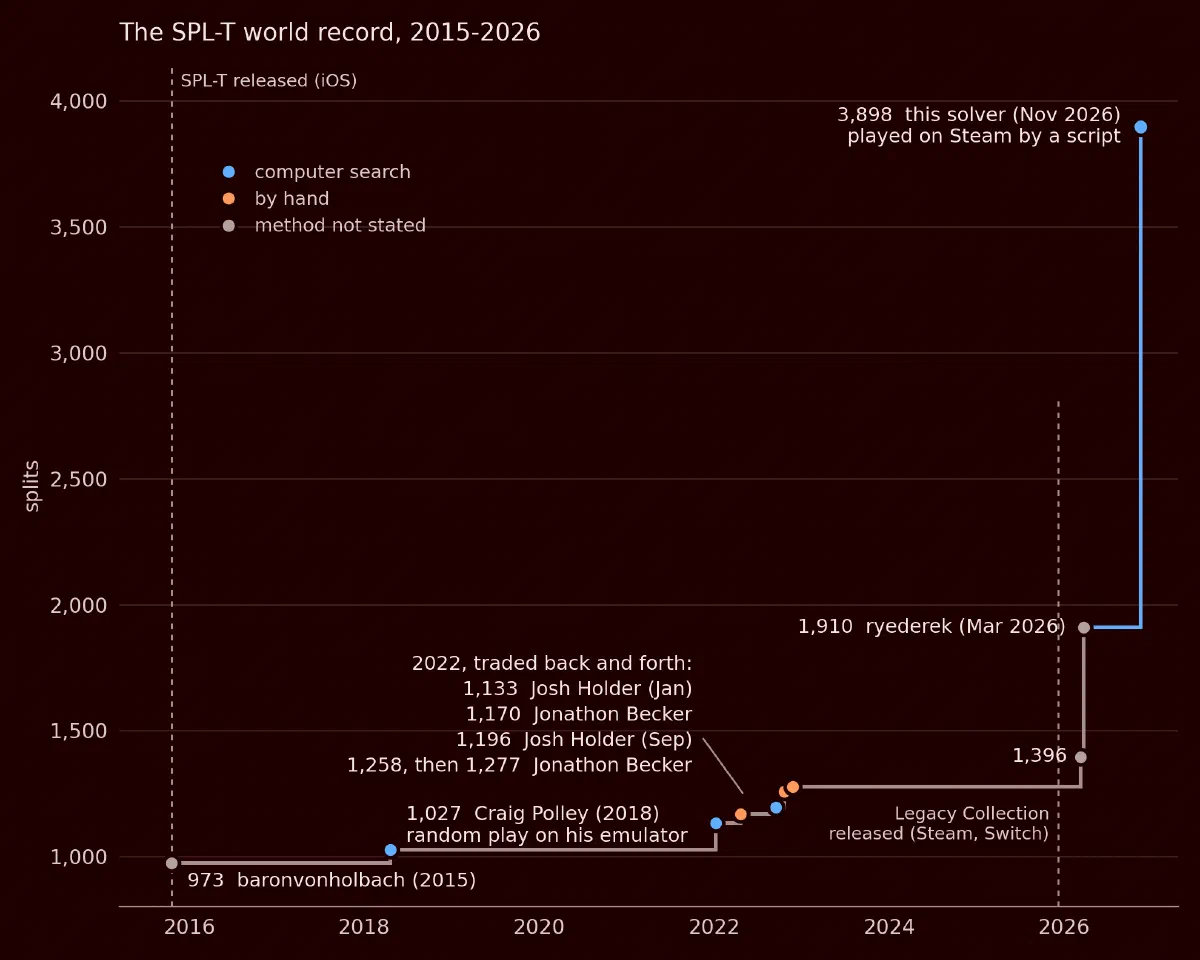
- 2015. Somebody with the handle baronvonholbach posted 973 splits the year the game came out.
- 2018. Craig Polley wrote a Python emulator of the game and ran random games on it for days. Random play dies around move 100 on average, but with enough games he found a 1,027-split sequence. He also worked out that exhaustive search is hopeless: if every atom in the universe were a computer, they could only have explored the game tree about 100 moves deep. (His site is offline now; the argument survives as a quotation in Josh Holder’s write-up.)
- 2019 to 2022. Josh Holder built on Polley’s emulator. He wrote a hand-tuned scoring function for moves and a backtracking search on top of it, which reached 1,053 splits by algorithm alone and 1,133 with some human help. The 1,133 took the record in January 2022. Jonathon Becker, playing by hand as far as anyone knows, answered with 1,170. Holder ran his search for another 36 hours and 700,000 games and took it back with 1,196 (1,208 with human help); his write-up is from that September, and his code and sequences are on GitHub. Becker then posted 1,258 and 1,277.
- 2025 to 2026. Nothing for three years, until the Simogo Legacy Collection brought the game to Steam and Switch in December 2025. A Bluesky user, ryederek, posted a chart of the record history, and three months later posted 1,396 splits and then 1,910, each with a screenshot of the final board. That is the best public claim I know of. ryederek has not said whether a computer was involved.
This project starts from Josh Holder’s work. The engine is a port of his Python emulator, and the first two searches below are built around his move-scoring heuristic, ported constant for constant.
Getting the rules exactly right
Reviews and strategy guides describe the game loosely. They disagree about what counts as a cluster, and they say nothing about rounding or about how holes refill. You cannot simulate from that.
Josh Holder’s emulator is the closest thing to ground truth: his record games were computed on it, and a record only counts once it has been played on the real game. I ported it to Rust and kept the exact block ordering, so that his published sequences could be fed straight in. The port replays all four of his published games, 4,590 moves in total, and each game ends on exactly its last move. The refill rules are strange. Single-column holes never refill. A hole of odd depth leaves its top row empty. All of it is kept, because the quirks are the game. The engine plays about 2.7 million moves a second on one core. (The Steam version has since agreed with it on every one of the record game’s 3,898 positions; more on that at the end.)
How a long game works
By move 600 or so, every strong game looks the same: four columns of clusters, each two cells wide. I’ll call them pipes, and letter them A to D from left to right.
A pipe

A new cluster is worth the move number, n. Each explosion beneath it halves it. Sixteen rows hold eight clusters, so a cluster at the top of a full pipe has seven beneath it and is halved seven times on the way down. It reaches the bottom worth about n/128, less the turns it spent waiting. Work that through and a full pipe explodes about once every n/265 moves: every seven or eight moves at move 2,000, every fourteen at move 3,700. Pipes slow down as the game goes on, and there is no way round it, because there is no room for a ninth cluster.
A pipe has to be given exactly one new cluster per explosion. Miss one and the pipe is a level shallower from then on, which doubles the time between its explosions.
The budget
Every move is a split, and the splits have to come from somewhere. A free block can be split one time fewer than it has cells before it is all single cells: three times for a block of four, seven for a block of eight. An exploding 2 by 2 cluster leaves a hole that refills as one 2 by 2 block, which is worth three splits, and it takes exactly three splits to turn that block into the next cluster. So a pipe pays for three moves every time it explodes, and the game comes down to whether the pipes explode often enough to pay for one move per move.
They do, until the interval between explosions gets too long. Four full pipes return twelve splits per interval, so they keep up until the interval reaches twelve moves, which is around move 3,180.
There is one way to get more out of the same explosions. If two neighbouring pipes explode on the same move, their two holes refill as a single block four cells wide, and that block is worth seven splits where two separate blocks are worth six. Two pipes that hold identical stacks do this every time. I’ll call them a pair.
| What the board runs on | Splits back per interval | Keeps up until about move |
|---|---|---|
| Three pipes, two of them a pair | 10 | 2,650 |
| Four pipes | 12 | 3,180 |
| Four pipes, one pair | 13 | 3,445 |
| Four pipes, two pairs | 14 | 3,710 |
Past that point a game is living on whatever spare blocks it has on the board, and it ends when they run out.
Three searches
Play it out
The first attempt was a beam search with an evaluation function built from scratch. It reached 522 splits. The telling experiment was to resume Josh Holder’s 1,208 game at move 900: beam widths from 50 to 4,000 all died around move 1,050. More search did nothing, so the evaluation was wrong. The record boards showed how. Good play keeps 90 to 120 of the 128 cells full of point blocks, and an evaluation that rewards free space pushes the other way.
So the next step was to stop inventing and port Josh Holder’s heuristic, 500 lines of Python with hand-picked constants. The port was checked by dumping his scores at all 4,590 record positions and comparing them with the Rust version: no mismatches. Two things came out of that. His record games are 98 percent greedy: at almost every position, the record move is the heuristic’s first choice. And the heuristic is brittle alone. Resumed from an arbitrary position in a record game, greedy play dies within about a hundred moves.
The idea that worked was to keep the beam search and change what it measures. For each candidate position, play the heuristic greedily and count how many moves it survives, up to 200. That count is the position’s score. A search 100 positions wide takes under a minute and reached 1,885 splits from an empty board, and 2,064 with two extra randomized play-outs per position. The same settings with a different random seed land anywhere from about 1,050 to 1,900, so the best games come from running many.
Rework the ending
The next gains came from searching around the best game instead of starting again. The first version, which I called the ratchet, cut the best game somewhere in its last 400 moves, searched again from there with a new seed, and kept the result if it was longer. About a day of that took the 2,064 game to 2,670.
Then the play-outs changed. Instead of asking the heuristic for every move, a play-out replayed the move the best game itself had made at the same point, whenever the same block was still on the board. A position on the game is then worth exactly what the game went on to score, and a position off the game is judged by whether it can get back onto the game’s schedule. Kicking the game somewhere near its end and letting this search repair the damage took 2,670 to 3,012 in under an hour, and with one more refinement to 3,103 and finally 3,140.
Those games found the pair by themselves. From about move 2,400 two of their pipes hold identical stacks and explode together. They also all do one thing with the fourth pipe:
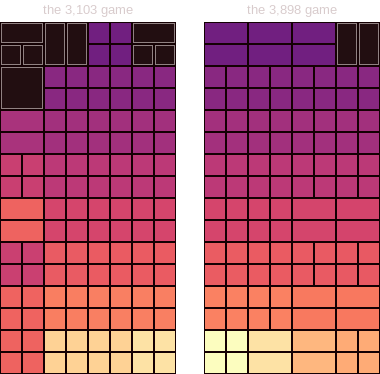
These searches never waste a split. Whenever the pipes return more than the game can spend, the extra goes into clusters in the wrong place in pipe A, on top of spare blocks or underneath older clusters. Those clusters come back hundreds of moves later, when the other three pipes have fallen behind. That store is why these games last 490 moves past the point where three pipes stop keeping up. It is also why they stop where they do. Pipe A never works as a pipe again, and no amount of searching around a game like that turns it back into one. I tried: handed a position with a clean fourth pipe, the same search wrecked it within 150 moves.
Count the depth
The search that found the record game is the simplest of the three. It is a beam search over every legal move, and it never plays a game out. It scores a position by counting, for each pipe, how many separate explosions its stack of clusters will produce. Two clusters that will reach the bottom together count once, and a pipe that is waiting for its next cluster is credited with it in advance. That count is the pipe’s depth, eight at most. The search keeps the positions with the greatest total depth. It refuses to make a cluster anywhere but on top of a stack, unless it has no other move. Among positions of equal depth, it prefers the ones where two neighbouring pipes are going to explode on the same move.
Nothing in it knows what a pair is, or how a pipe gains a level, or what to do with a surplus. Positions that handle those things well keep more depth than positions that don’t, and that turns out to be enough.
What it does with a surplus is the surprising part. A board with more depth than the move number needs gets more splits back than there are moves to spend them on, and a board that is nearly all clusters has nowhere to keep them. The second search stored them in pipe A. This one throws them away:
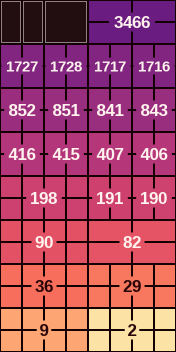
The record game does this about 150 times after move 700, at a cost of 632 splits. It looks like waste, and the earlier searches could never have found it, because a wide cluster costs four moves now and pays nothing back for hundreds. But it buys depth: the game reaches the late stages with four full pipes instead of three.
The first run of this search started from move 700 of an earlier game and produced a 3,588-split game in eight seconds. A second run from move 2,600 of that game, with the preference for shared explosions switched on, produced 3,898, also in eight seconds. Where a run ends depends on what it has built by the end, and the table above predicts it:
| Structure at the end | Keeps up until about move | Runs that ended past it |
|---|---|---|
| Four pipes | 3,180 | 33 runs: 3,306 to 3,443 |
| Four pipes, one pair | 3,445 | 301 runs: 3,468 to 3,652 |
| Four pipes, two pairs | 3,710 | 34 runs: 3,712 to 3,898 |
That is 432 runs from moves 2,300 to 3,100 of the 3,588 game, with different seeds and settings; 64 more failed outright. I sorted them by where they ended and only checked the structure directly for the best one, so the left-hand column is the model’s reading, not a measurement.
The search also leaves a family tree behind. The second run kept 1,000 positions at every move, each descended from one of the 1,000 before it, and the chart below follows those lines of descent the way a chart of virus variants follows lineages.
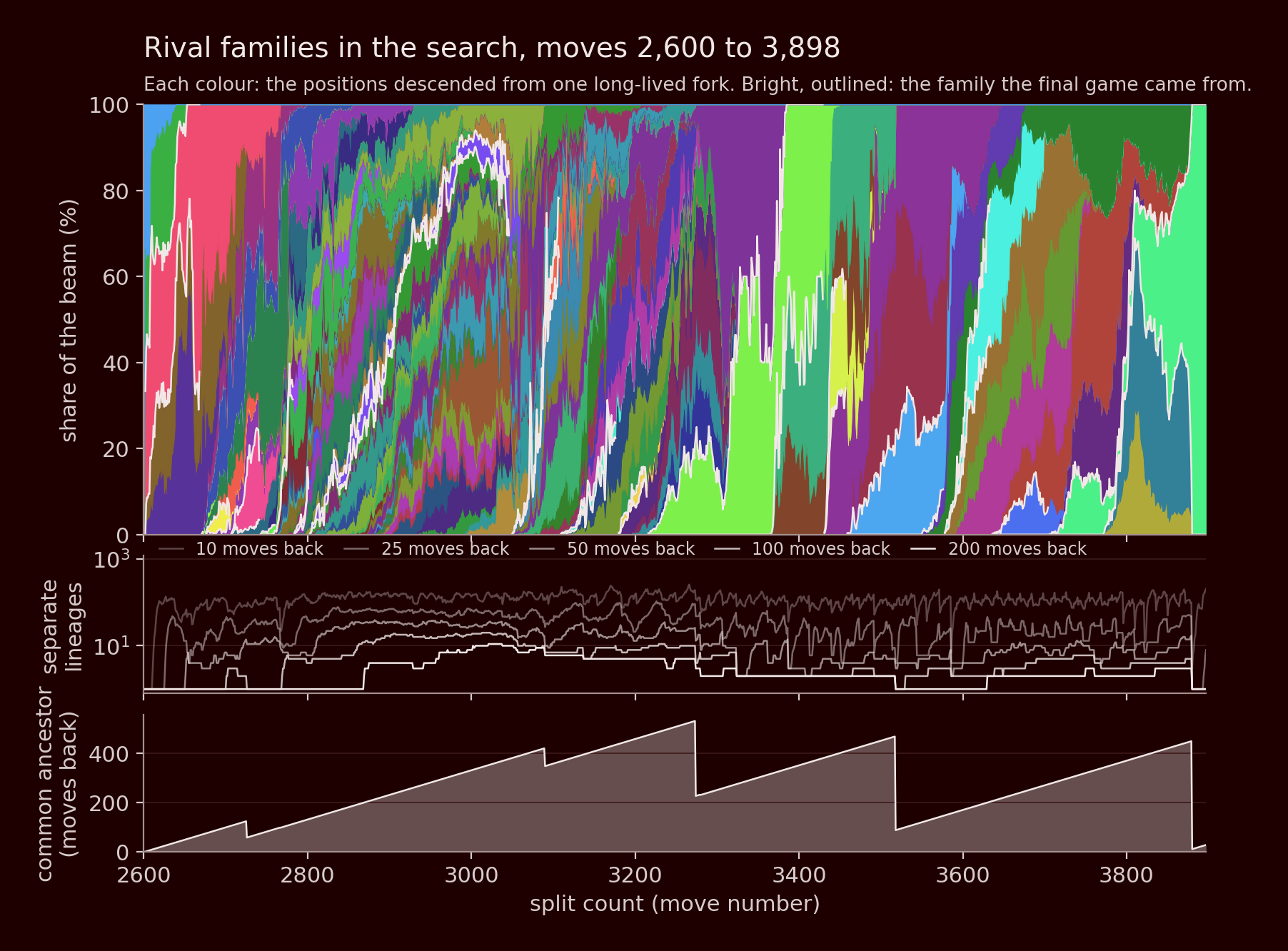
I expected a search like this to collapse onto one line of play every few dozen moves, and the first run does: at a width of 300, its positions typically share an ancestor 49 moves back. The second run does not. Its common ancestor is typically 292 moves back, and at move 3,273 it was 532 back: every position in the search still came from one of two branches that had parted at move 2,741. Five times an old family dies out, and the sawtooth at the bottom drops. The family that led to the final game was often one of the small ones. As the chart draws it, it holds less than a tenth of the search on more than half of the moves.
What keeps the families apart is a rule in the search that I have not mentioned yet: positions that have burnt the same amount of capacity may take at most 40 percent of the places. In this run the families mostly differ in how much they have burnt, so none of them can crowd the others out, and they run side by side for hundreds of moves until one loses a level. That cannot be the whole explanation, because the first run has the same rule. The wider beam is probably the rest of it.
Two cautions. Most runs from early in a game fail: about nine in ten die within 150 moves, because the position they take over still holds the previous search’s store, which this search will not touch. And I should say how close this came to not being found. My first version died within a hundred moves from every position I tried. I took that as evidence against the idea and spent an hour building a careful planner instead. The cause was one line: the test that refuses a cluster with a point block above it was counting the new cluster’s own blocks, so the search could never make an ordinary cluster. I only ran it again after fixing that line for another reason.
The record game, phase by phase
Moves 1 to 700: the opening and the build-up. The first hundred moves cut the slab into pieces and decide which columns become pipes. By move 176 every pipe holds three clusters, and by move 621 seven. The stacks are lumpy at first, because clusters made a few moves apart sit on top of each other with nearly equal values. This part was played by the first search, and it is the same opening every one of the solver’s long games has used.
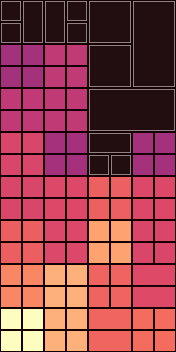
Moves 700 to 2,510: the keeper takes over. From here the game is played by the depth-counting search. The four pipes hold between 27 and 31 of the 32 possible levels, and the missing ones are added one at a time. Gaining a level is the most delicate thing in the game. A pipe makes two clusters in one interval, timed so that they reach the bottom exactly one move apart, and then a third cluster has to be completed on precisely the second of those two moves. It has one move to do it in, so it borrows from its neighbour: one horizontal split turns a fresh block into two 2 by 1 blocks beside two that the next pipe has kept waiting, and the four become a cluster across both pipes. This is also where most of the burning happens, 117 wide clusters in 1,800 moves.
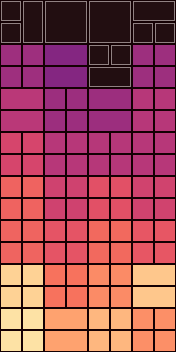
Moves 2,510 to 3,640: four full pipes, then two pairs. From about move 2,510 every pipe is eight clusters deep and stays that way. Pipes A and B explode on the same move from about move 2,850, and pipes C and D from about move 3,300. The burning thins out as the move number catches up with what the pipes return, and the last wide cluster is made around move 3,520.
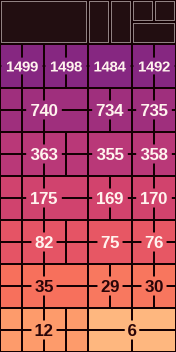
Moves 3,640 to 3,898: the fourteen-move cycle. Nothing is burnt any more. Each pair explodes every fourteen moves, and its four-wide block takes exactly seven splits to become the next two clusters. That is fourteen splits back every fourteen moves. Pipes C and D explode six moves after pipes A and B in nearly every cycle from move 3,300 on (37 of 39), so the two blocks are always being worked on at the same time. They have to be. A fresh four-wide block cannot take a horizontal split, which would leave two strips one cell tall, so whenever a horizontal split is due and one block is fresh, the move comes out of the other pair’s half-finished block. The recipe is the same in every cycle while every number on the board creeps upward. The order of the cuts is not: it shifts with whichever direction is due, and no cycle repeats the one before it move for move.
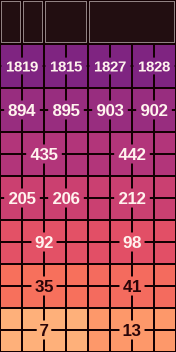
The interval between explosions is the move number divided by about 265, so it keeps stretching. Past move 3,710 it is longer than fourteen moves, the pairs fall a fraction of a split behind on every cycle, and the few spare splits on the board run out. On move 3,896 pipes A and B explode, and their new block is the only free block on the board. The next split has to be horizontal. That cuts the block into two strips one cell tall, and nothing on the board can be cut horizontally again. One vertical split later the game is over, with the next explosion four moves away.
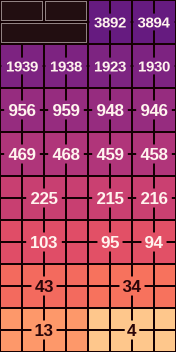
How long could a game be?
Two facts give a hard ceiling. Splitting capacity is conserved: the engine’s own bookkeeping for the record game is 127 splits in the starting block, plus 4,540 from refills, minus 764 lost to clusters of larger blocks, minus 5 left over at the end. And a cluster is two rows tall, so no block can ever have more than seven clusters beneath it. From those two, no game can pass about 4,700 splits, and that bound assumes refills bigger than any real structure gets.
For a structure that can actually run, the table is the answer. Two pairs is the largest one. All four pipes exploding together would return fifteen splits per interval instead of fourteen, which would move the last row of the table from 3,710 to about 3,975. It cannot be done, because the single eight-wide block they would get back cannot be split by itself. A horizontal cut turns it into two strips one cell tall, and nothing else on the board is there to take the horizontal turns. An exhaustive check with the engine finds at most 9 of its 15 splits, and 2 if a horizontal split is due when it arrives. I also built boards with all four pipes in step, by copying one half of a late position of the record game onto the other half. From six such boards between moves 3,500 and 3,710 the search ends exactly 23 moves later every time: 14 on the two blocks already there, 9 on the eight-wide one. Two pairs a few moves apart can lend each other moves. Four pipes in step cannot.
So a game built this way ends a little past move 3,710, and how far past depends on the spare splits it carries. This one carried almost none. From move 3,300 onward, every variation of the search I tried ended on exactly 3,898 or earlier. Josh Holder’s estimate in 2022 was 3,700 for the theoretical maximum and about 1,800 for what is practical. My own guess, when the best game stood at 2,620, was that the true maximum was about 3,000. That guess described the searches I had, not the game.
What could still move it: the first 700 moves have never been searched with the new method, since it cannot yet start from a board that young, and nearly all its runs from early positions fail. A different opening might carry more spare blocks into the end, and the same arithmetic says the most that could be worth is about 150 moves. So my guess for the true maximum is now somewhere between this game and about 4,050.
On the real game, played by a script
A record in this game has always meant a final screen from the real game. On November 16, 2026 a script played the 3,898 sequence on the Steam version of SPL-T, in the Simogo Legacy Collection. It moved the game’s own pointer from block to block and clicked. After every click it read the board off the screen and compared it with the engine’s position before making the next move. All 3,898 positions matched, the game ended on the last move, and the game’s own score screen came up:
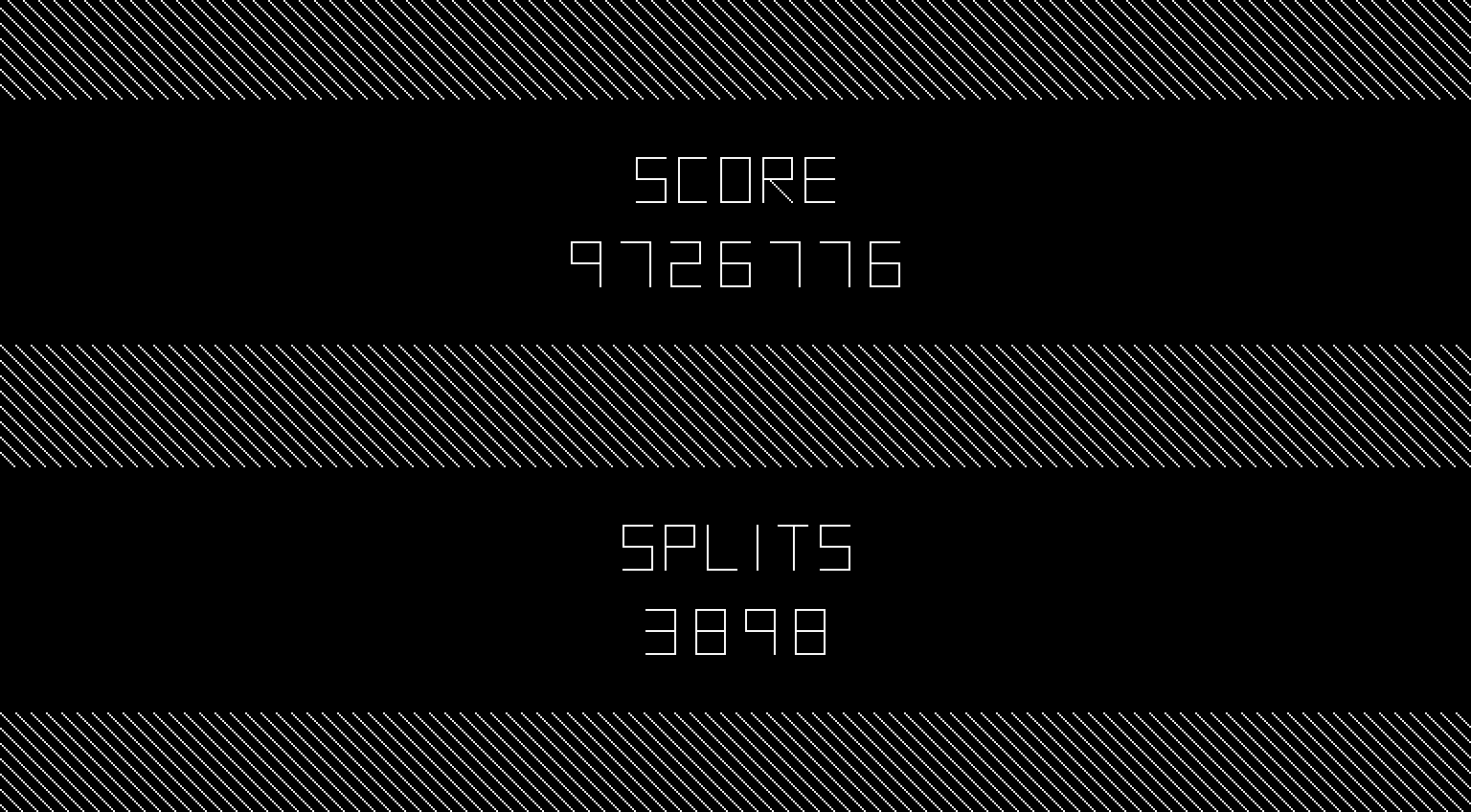
The run took 29 minutes: clicks at least a tenth of a second apart, and a wait for each explosion to finish. It was recorded: see the video at the top of this post.
The run also settles a rules question. The engine is a port of an emulator of the 2015 iPhone game, and it had been checked against 4,590 moves of published record play. The record game’s late play is built from four refill situations that all occur in those published games, but its first 900 moves pass through a few rarer ones that they never produced, such as sixteen point blocks exploding at once. The Legacy Collection agreed with the engine on all of them.
What this is not is a game played by hand. Nobody has tapped out 3,898 blocks in order without a mistake. The solver’s sequences are lists of internal block numbers, so the repository also has a page that shows the board and highlights the block to tap on each move, for anyone who wants to try. Whether a script’s clicks count toward the record is not for me to say. There is no leaderboard and no rulebook.
And the hard part was not new. Craig Polley wrote the emulator and did the arithmetic that said brute force was hopeless. Josh Holder wrote the strategy down as code, proved it on the real game, and published all of it; his heuristic still guides the first 700 moves of the record game. The code is at github.com/jackson-wxyz/spl-t-solver, with a research log that records every experiment, including the ones that made things worse.