Peace Through Prophecy: an AI Worldbuilding Project
In 2022, the Future of Life Institute ran a $100,000 worldbuilding contest: design a plausible, aspirational future where humanity has safely navigated the invention of artificial general intelligence. Out of around 150 submissions, our three-person team’s entry — “Peace Through Prophecy” — took second place.
Our scenario asks: what if experimenting with governance led us to collectively make wiser decisions? Look around at humanity’s fractious politics, at the essentially lawless competition of international relations, and at our fumbled response to familiar threats like viral pandemics. Our civilization isn’t exactly well-prepared to safely manage the deployment of unpredictable and incredibly powerful AI technology. But how do we get from where we are now, to where we want to go? In our utopian scenario, we imagine:
- How governments could use mechanisms like prediction markets and liquid democracy, along with AI-enhanced research/analysis tools, to collectively make wiser decisions and capably execute big projects.
- How positive changes could spread to many countries via competition to achieve faster economic growth than rivals, and via snowball effects whereby passing one reform makes it easier to pass others.
- How the resulting, more-capable civilization could recognize the threat posed by misalignment of powerful AI systems, and internationally coordinate to create a solid plan for safely developing aligned superintelligent AI.
Explore the world
- Timeline: 2023 - 2045 — a year-by-year future history: from AI-assisted local governance experiments, through the Flash Crash War, to the Delhi Accords and the Alignment Project.
- A Day in the Life in 2045 — two short stories by Holly Oatley, following a construction specialist and a pair of diplomat-programmers through the world of 2045.
- Answers to the Contest Prompts — our full answers to the contest’s 13 detailed questions: how AGI stayed safe, how arms races were avoided, what happened to inequality, how people find fulfillment, and more.
- The original entry on worldbuild.ai — FLI’s official page for our world, including their interactive timeline widget.
The mural
Diana Gurvich painted a panoramic mural illustrating our scenario — governance innovation on the left, the Flash Crash War in the middle, and the Delhi Accords’ golden age on the right. Click through for the full-resolution original.
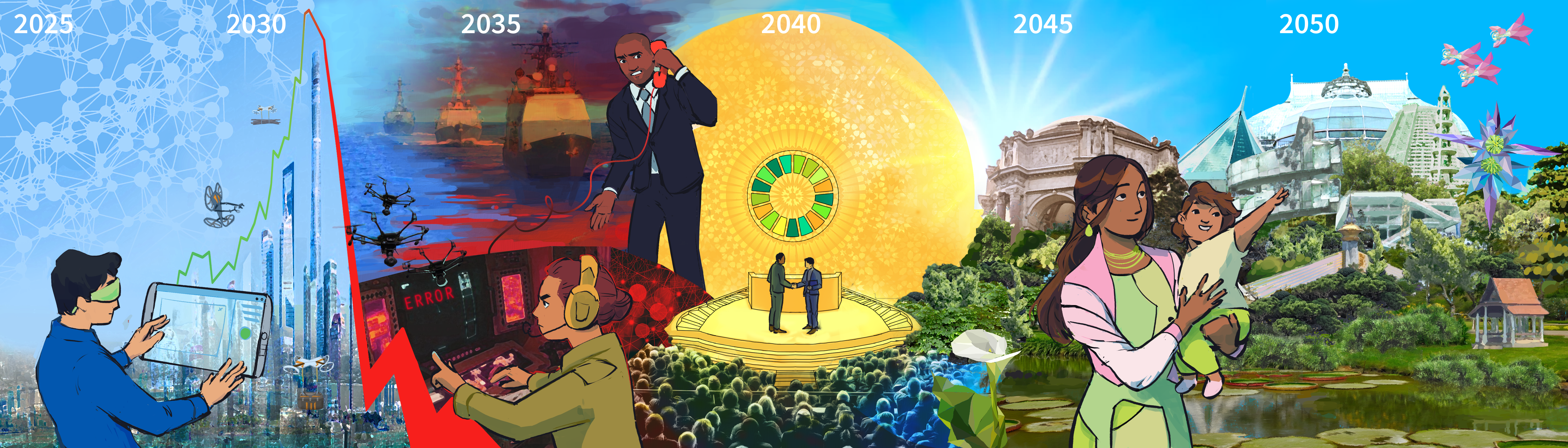
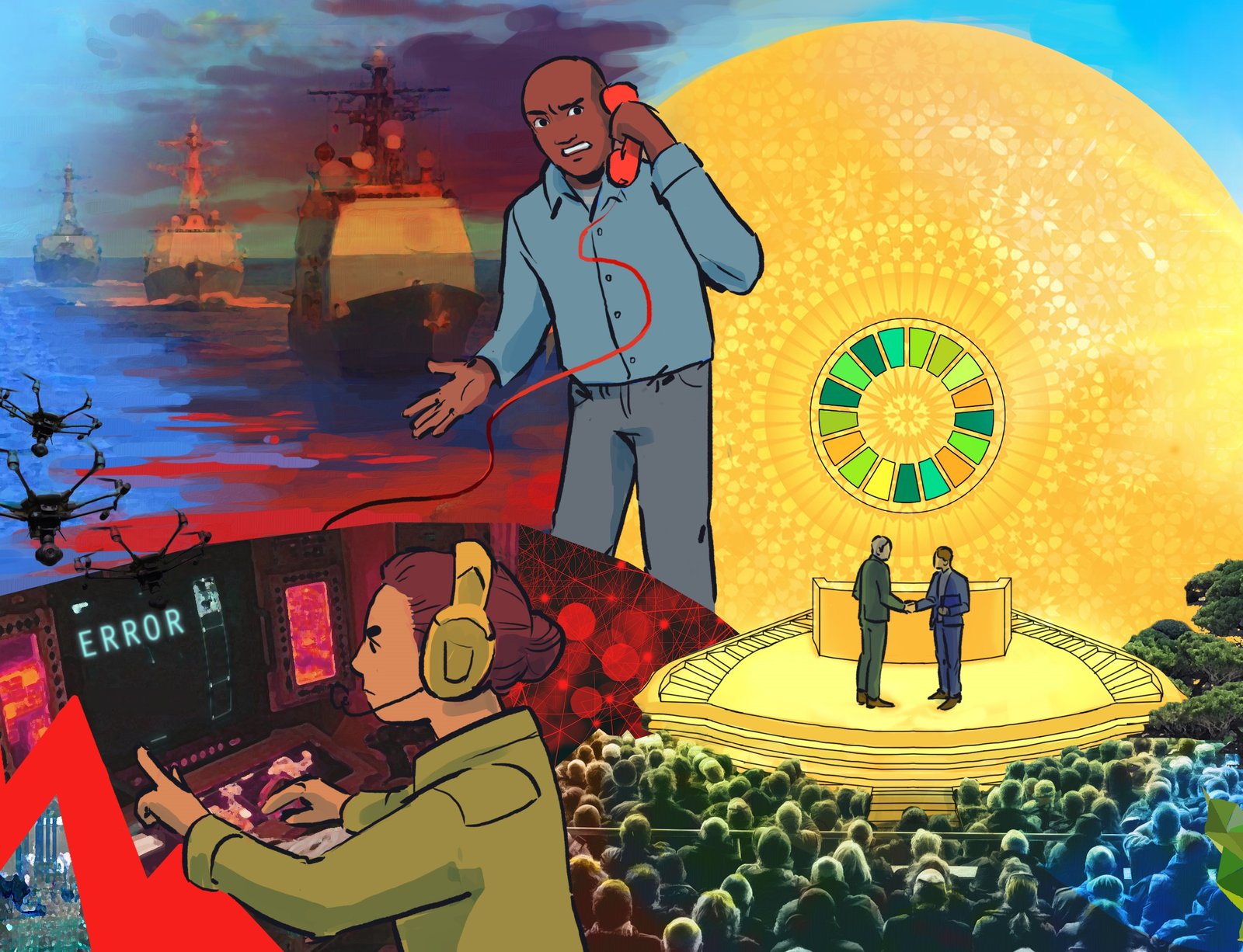
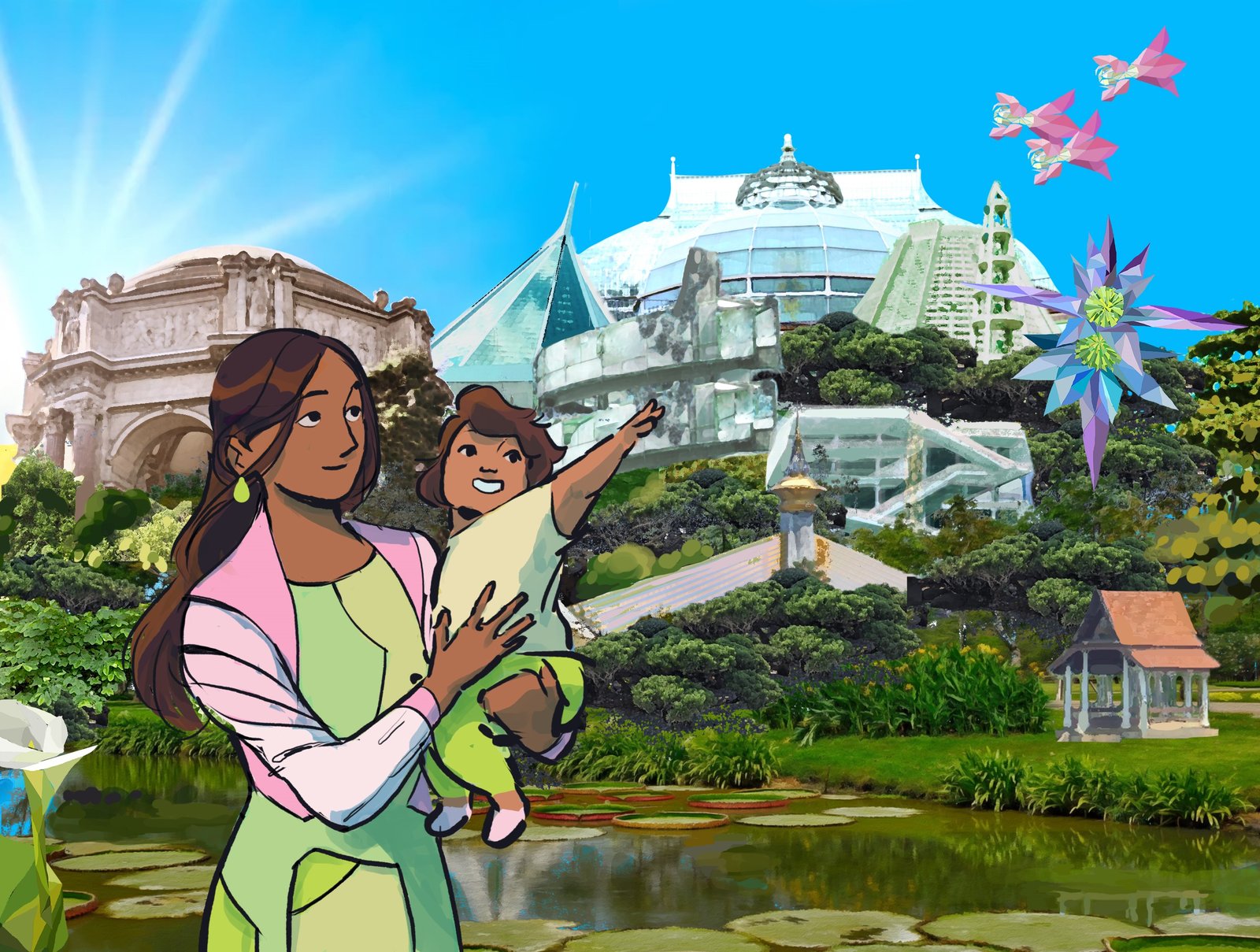
The podcast episode
FLI followed up on the contest with a podcast series, “Imagine A World”, digging deeper into the eight winning entries. The first episode, “What if new governance mechanisms helped us coordinate?”, features Holly and me discussing the ideas behind our world with host Guillaume Riesen. (Also on Spotify, Apple Podcasts, and SoundCloud.)
Some of my favorite moments from the interview:
- At the 11:15 mark, we introduce the overall historical arc of our scenario, then move on to talk about how new institutions like prediction markets and charter cities could improve humanity’s ability to make wise decisions and coordinate on global problems.
- At 27:12, talking about how a rapidly-changing landscape of AI capabilities will create a lot of uncertainty about who the ultimate “winners” vs “losers” will be. This uncertainty might actually make international coordination easier, creating a situation like the “veil of ignorance” thought experiment from philosopher John Rawls.
- Around 38:30, Holly and I gush over some of the sci-fi stories that we took inspiration from — books like Ada Palmer’s Too Like The Lightning, Ursula LeGuin’s The Dispossessed, and Yudkowsky’s Inadequate Equilibria — that take improvements in “social technology” just as seriously as advancements in science and engineering.
Discussion & related posts
- [Fiction] Improved Governance on the Critical Path to AI Alignment by 2045 — my EA Forum post presenting the motivation behind the scenario, with selected excerpts. (LessWrong crosspost)
- Here are the finalists from FLI’s $100K Worldbuilding Contest — my tour of the other finalists’ worlds.
- FLI podcast series, “Imagine A World” — my highlights from the first four podcast episodes.
The team
- Jackson Wagner conceived the overall scenario and wrote the timeline of events and the short-answer responses. (That’s me! You’re on my website.)
- Diana Gurvich painted the mural illustrating our scenario. See more of her work on Instagram.
- Holly Oatley wrote both short stories. She is a speculative fiction writer with an interest in history and sociology; you can follow her writing on Tumblr.