Timeline: 2023 - 2045
Part of Peace Through Prophecy, our team’s entry in the Future of Life Institute’s 2022 AI worldbuilding contest. The contest required each year to feature two notable events; here is how our imagined world gets from here to 2045.
2023
Xi ends term amid pressure. Facing protests over China’s failed zero-covid policies, Xi is forced to name a successor rather than take a third term, and the title of Paramount Leader passes to the head of a prominent minority faction.
Starship orbital flight. First orbital flight of the “Starship” reusable heavy-lift launcher; busy manifests of satellite cargo and nasa lunar missions will keep this rocket busy through much of the 2020s, but the first human mars landing occurs in 2028
Twitter prediction markets for news. Under new management, twitter pilots play-money prediction markets as a new way to create trustworthy news & expertise on divisive political issues.
AI enhances research & forecasting. Researchers and forecasters benefit from innovative use of language-model-based AIs to automate basic claim-evaluation via delegated AI argument generation and judgement, scientific literature search, and forecasting assistance.
2024
China local-gov revitalization campaign promotes AI. China, seeking to revive economic growth, begins a campaign where they encourage local governments to utilize AI in order to automate government services. Industry partnerships are set up between governments and leading tech companies / labs to assist this transition. In retrospect, this had much wider consequences than its planners anticipated, although some historians think that some variety of good-governance feedback cycle would probably have happened eventually (albeit perhaps too late) due to the many in-retrospect-obvious synergies between AI capabilities and societal organization/planning/administration.
high-quality VR glasses. Meta releases their first-gen AR glasses, which use hand-tracking to let the user interact with a virtual world and talk via holographic telepresence with friends & coworkers. In future years, virtual reality and AR technology will improve steadily, ultimately having a large impact on the structure of the economy and how humans work.
2025
AI algorithmic improvements. Improvements to AI algorithms lead to dramatically increased performance in areas involving memory and spatial reasoning (eg, language models being able to keep to a coherent theme for multiple paragraphs, remember details in a chat, and do math correctly).
Satellite internet aids development. Internet megaconstellations like Oneweb, Starlink, and Kuiper provide high-bandwidth, low-latency connections throughout developing world and rural areas, further opening up the map and boosting the trends of remote work and “virtual immigration” that will become most influential around 2030.
2026
futarchy in Jiangsu province. First futarchy-style prediction market, with limited but significant formal power to shape policy, is introduced in jiangsu province. Traders quickly learn to make use of Elicit-style AI research assistants and forecasting tools to help them wrangle contradictory evidence on policy outcomes. The basic structure and functioning of most futarchies in 2045 still bears strong resemblance to the Jiangsu system, albeit individual traders are now accompanied by extremely sophisticated prediction-market trading organizations (like a combination of Wall Street quant fund and DC think-tank).
affinity cities attract remote workers. Numerous small towns rebrand as “affinity cities” catering to unique interests and lifestyles, as gen-z homebuyers favor remote work rather than prohibitively expensive urban living. Later, other affinity cities are created wholesale via crypto fundraising and assurance contracts.
2027
china devolves power to provinces. Rather than naming successor to take role of paramount leader in 2032, china’s current leader (under pressure from a faction of provincial governors on the Central Committe) announces that the role of Paramount Leader will be split: General Secretary of the Chinese Communist Party will now be a seperate office from the person who leads the PLA and acts as President of the People’s Republic of China. In five years, this change takes effect, effectively creating a duumvirate overseen by Central Committee.
AI ups farm efficiency. AI’s ability to navigate complex real-world environments and carefully handle physical objects creates a boom for agriculture. rather than growing single crops in giant monoculture fields, farmland can now switch to higher-density “silvopasture” methods. Silvopasture involves growing multiple complementary crops to enrich soils; it is more environmentally friendly and more profitable per-acre, but was prohibitively labor-intensive before the invention of AI-enabled robotic picking machines.
2028
first glimmers of commercial fusion. A newly-constructed fusion test reactor at a research university in Hubei proves able to sustain net-positive energy production. In future years, a hugely scaled-up and streamlined version of this design will be mass-produced for export in china’s northern “rust belt”, eventually providing much of the world with cheap baseload power.
carbon-capture takes off. Prometheus Fuels completes the first of five gigafactories for producing direct air carbon-capture fuel plants; in future years these and competing designs will scale to fully decarbonize earth’s remaining gas-powered transportation systems and go on to pull past carbon emissions from the atmosphere.
2029
futarchy & AI fuel China boom. China’s annual growth rate hits 15% in one year, among the highest figures ever recorded for a large nation (aside from one-off recovery years after civil war or hyperinflation).
live AI translation now commonplace. Language models allow instant high-quality translation & tone, they are used confidently by tourists and businessmen for all but the least documented languages.
2030
self-driving cars finally work great. Self-driving cars now easily navigate crowded traffic situations; people quickly adopt the convenience of being free to relax or work during transit.
charter cities spring up in global south. Charter cities become an attractive source of income to developing countries, attracting many startups from the first world which are burdened by outdated regulation.
2031
Iran / UAE conflict shows AI’s military potential. A series of tit-for-tat missile attacks between Iran and the UAE breaks out in the Persian Gulf, as Iran attempts to blocade the straits of Hormuz. The UAE decisively wins the conflict, thanks in part to AI integration in military tools to quickly recognize threats, predict enemy movements, and get inside the enemy’s OODA loop with unprecedented speed. A small skirmish, this event nevertheless plays a big role in accelerating the dangerous trend of military forces seeking to integrate AI systems.
youth frustration with schlerotic USA politics. Ideological youth movements thrive in the USA despite increasing disaffection with its comparably sclerotic formal political system: 8% of ivy league graduates describe themselves as identifying more strongly as an “effective altruist” than they identify with their political party.
2032
USA wave election on pro-growth reform platform. Disappointing GDP compared with china’s sudden growth, a threatened image of superiority, and the prospect of the best jobs going across seas leaves the electorate disconent with the present course and they elect a technocrat who declares a new USA that will embrace AI. This is disconcerting but cautiously embraced because the alternative seems to be to fall into China’s shadow forever. Something which both parties are keen on.
startup’s sats enhance GPS accuracy & security. Xona Space Systems deploys Phase 3 of their commercial GNSS constellation, providing centimeter-accurate positioning services throughout the world. After going public at a $30B market cap, early employees rejoice and retire to a life of luxury. Precision GNSS boosts the capability of autonomous drones, self-driving cars, agricultural and maritime industries, and global shipping.
2033
AI algorithmic improvements. Significant AI breakthroughs enable a paradigm of “continuous learning” that does away with the strict distinction between training and deployment. Safety researchers think that, for various technical reasons, the new paradigm offers more hope for the feasibility of alignment, but are dismayed that the new models seem highly scalable and thus potentially put humanity on the precipice of disaster, pending 1-2 similar insights or hardware improvements.
new tests detect cancers early. Multi-cancer blood tests and genetically-customized immunotherapies have reduced the mortality burden of cancer by 55% across OECD nations.
2034
USA implements futarchy & liquid democracy. After the success of smaller-scale experiments, the United States implements a national “futarchy” system whereby laws that prediction markets judge likely to improve a basket of metrics, will automatically be implemented. Naturally, this is followed by a flurry of major reforms as markets eliminate counterproductive regulations that raise people’s cost of living, while implementing new laws designed to improve quality of life.
EU follows US reforms. The EU follows the USA in adopting a more limited set of policy and governance overhauls.
2035
military integration of AI intensifies. While the military has resisted passing control over to AI’s before, several dams break (or retire) and various military integration steps, like autonomous drones, offline android squads, and AIs filled in on the classified information that not even most generals are given access to, provide oversight
AI-designed medicines. using AI-powered simulations of protein folding and interaction, biologists are able to design new drugs with new levels of specificity, which is especially helpful for targeting aspects of brain function. New treatments mitigate severe mental illnesses and slow cognitive decline.
2036
US reform party reelected amid growing AI concerns. US political administration reelected albeit with smaller vote share; despite the prosperity and excitement of the modern era, people are increasingly frightened by the prospect that humanity could lose control of AI.
Market peak amid rising US/China tensions. Between-country and within-country inequality both peak in 2036; the following few years will see market tumult leading up to the Flash Crash war, and continuing until the Delhi Accords are signed in 2040.
2037
LW was right the whole time. An international open letter is signed by dozens of nobel laurates, top scientists, and former world leaders, decrying the state of AI and AI governance. Elsewhere, a highly-upvoted post on Lesswrong dot com makes the argument, “Sorry to say I told you so, but…”
bans on AI persuasion tools. AI persuasion tools banned in USA & EU after “scissor statement” incident causes riots.
2038
China/US “Flash Crash War” incident. A “flash crash war” incident between USA & china causes two ships with the whole crew to be lost to missiles fired from a feedback loop of military AIs on opposing sides, despite no human desire for such extreme escalatory conflict.
seeds of 2040 accords sown. In the aftermath of the Flash Crash War, superpowers conduct panicked high-level talks, and implement interim control strategies like clamping down on semiconductor supply chains. These talks, once soberly informed by prediciton market policy analysts, will eventually form the basis for the Delhi Accords.
2039
EU exports modular AI-governance tech. Seeking to stabilize geopolitics and mitigate the dramatic increase in between-country inequality that accompanied the past decade, the EU completes a program to modularize many of their AI governance services and offer them to developing countries as a form of aid and cooperation.
alignment research labs begin to coordinate efforts for Delhi Accords. Leaders of ai alignment research labs, such as redwood research, alignment research center, and openphilanthropy, are hired into gov positions alongside hundreds of tech workers from companies like google and microsoft, as part of the early work to create what would later become the Alignment Project.
2040
Delhi Accords for international cooperation on AI. Delhi accords signed by 155 countries; key provisions all come into effect.
apollo-like Alignment Project initiated. Alignment Project starts, combining the efforts & research centers of top nations in a bid to safely develop artificial intelligence that will reliably reflect human values.
2041
Accords drive development of global south. In order to meet the Accords’ targets for inequality reduction, a gigantic marshall plan is launched aiming to empower Earth’s poorer nations and bring them into the community of nations as equal partners in humanity’s future.
nuclear & biological disarmament. Nuclear weapons, biological technology capable of synthesizing viruses, and other potential “attack vectors” that could potentially be coopted by a rogue AI, are dismantled by consensus of the Delhi Accords signatory to reduce the “vulnerability surface” of humanity in case of misalignment disaster.
2042
control of semiconductor supply chain. In a system modeled after the control of nuclear materials, over 99% of the world’s computing hardware (mostly located in large databases) is now tracked & secured against being used by rogue actors for unsafe AI research.
mars & moon settlement. The population of Mars passes 200,000
2043
hopes rise for aligning AGI. By combining several promising techniques from labs around the world, the Alignment Project achieves its first success – a research-analysis and coding-assistance AI that appears robust to numerous failure modes even when scaled to moderately superhuman levels. This superhuman research and development system will go on to assist in the design of future, more powerful aligned systems.
space elevator construction. Earth’s first space elevator begins construction in Nairobi, Kenya.
2044
EU pilots wellbeing-maximizing AI control of economy. The European Union finalizes their new system for creating a hybrid, semi-planned economy, monitored by AI systems to create a more “human-centric capitalism” rewarding healthy behaviors, positive externalities, and rich social connection.
“impact certificates” create retroactive payday for influential early EA projects. Billions of dollars in retroactive public goods funding is now being allocated via markets for “impact certificates” each year – generally excellent results rewarding worthy scientific research and public works, although controversy ensues when a large prize is awarded to a seemingly niche utopian sci-fi worldbuilding project from 2022.
2045
humanity plans long-term future in the cosmos. Five years later, the next generation of negotiations begin to follow up and build on the Delhi Accords – assessing progress so far, adjusting direction as needed, and planning for humanity’s future after the experimental superintelligences designed by the Alignment Project are rolled out.
medicines targeting aging. In medical trials, elderly rhesus monkeys treated with combination of age-targeting therapies regained full youthfulness of a 10-years-younger monkey in 5 of 8 major categories of endpoint metrics.
Data points
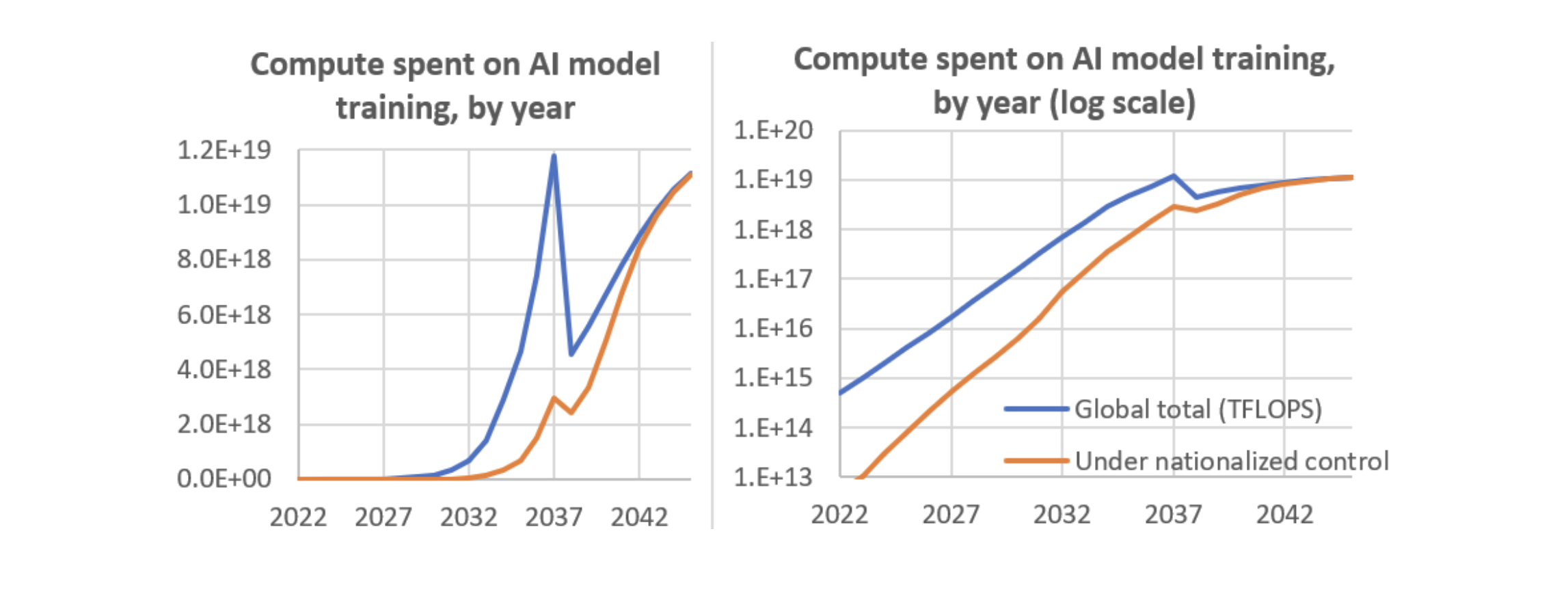
The contest also asked each team to provide a quantitative “data point” for every year of the timeline; here is the summary chart from our submission (click to enlarge):